
 Tom is a trusted advisor on procurement and third-party management to organizations across the United States. Having worked with over 120 organizations over his 30-year career, he has a unique ability to bring creativity and discipline to finding solutions for even the most complex challenges his clients face.
Most vendor management programs have friction. The question isn’t whether it exists, it’s whether anyone is paying attention to what it’s trying to say. Friction is a signal, and it almost always traces back to a crack in the foundation of how the program is built and run. Find the crack, fix it at the root, and the friction goes away. If you are seeing these signs, it is time for a vendor management program refresh. That’s what this article is about.
The short version
- Friction isn’t random. It traces back to gaps in the fundamentals that hold your program together
- Buying new technology without fixing the foundation doesn’t remove friction. It amplifies it
- A compliance-first program is a strategy problem, not a process problem
- Untrustworthy vendor data blocks good decisions and AI adoption. It’s often where everything else breaks down
- A vendor management program refresh starts with an honest assessment, not a rip and replace.
Table of Contents
I can usually tell where a vendor management program has friction within the first conversation.
Someone mentions that onboarding takes 45 days. Or they can’t find vendor contracts. Or that vendors sometimes start work before a risk assessment is completed.
These aren’t uncommon problems. They’re friction points – predictable places where things get stuck or quietly break down. And they show up in organizations of all sizes, across industries, at every stage of maturity.
Here’s the thing about friction: it’s a signal.
It’s telling you something is broken underneath, a gap in how the program is structured, resourced, or governed. And that’s actually good news, because a signal can be followed. Every friction point has a root cause, and every root cause can be addressed through a strategic vendor management program refresh.
The organizations pulling ahead aren’t the ones with no friction. They’re the ones who stopped treating it as background noise and started asking what it was trying to tell them. With vendor relationships getting more complex and carrying more risk than ever, the cost of not listening is growing.
Here are five common friction points I see, what’s typically causing them, and what addressing each one unlocks.
Friction Point 1:
Things Get Dropped Too Often
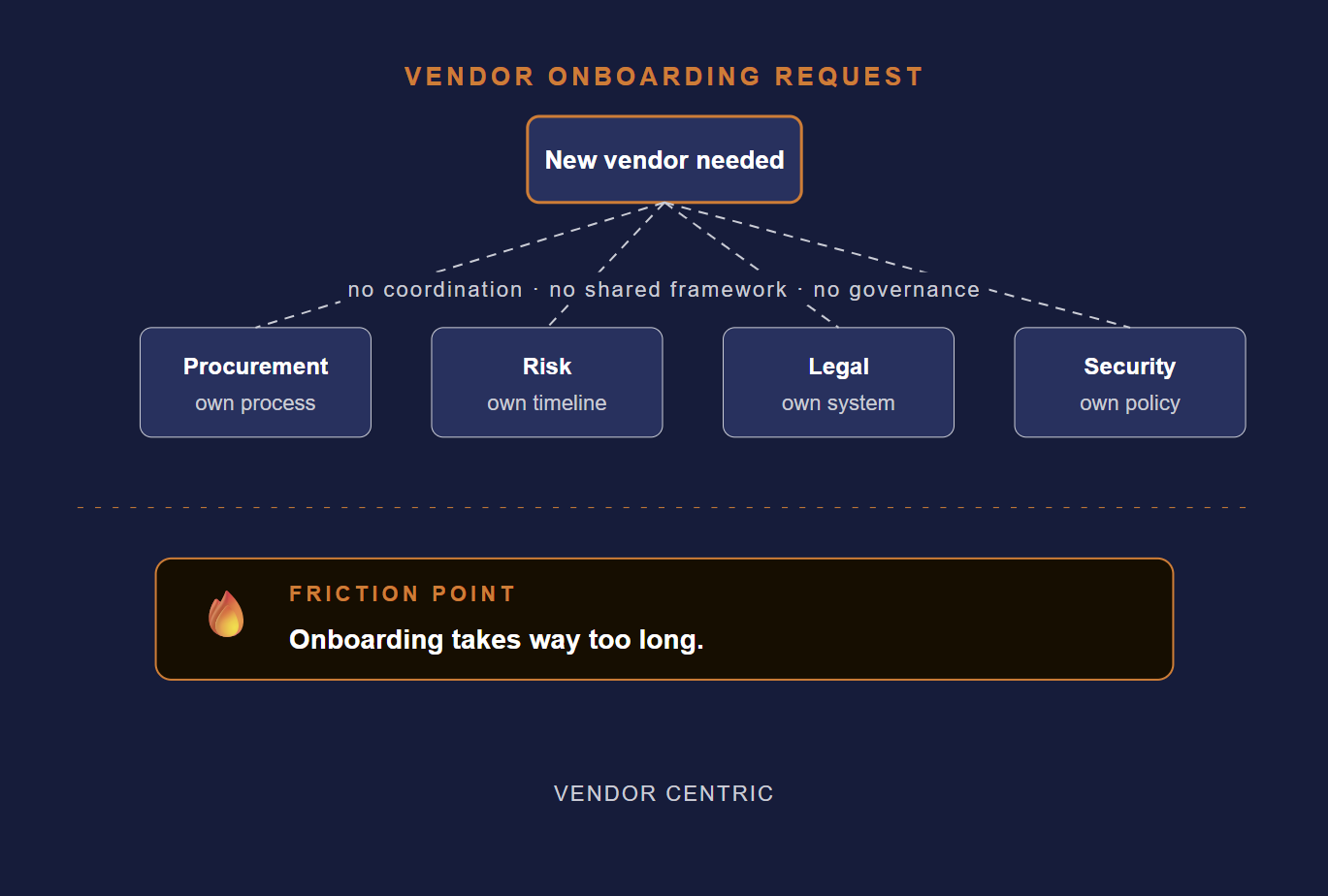
Every new vendor relationship follows the same pattern. The business identifies a need. They find a vendor. Then it gets complicated.
Procurement starts their process. Risk gets triggered and launches their assessment. Legal jumps in on the contract. Information security begins their evaluation. Everyone’s working hard. Nobody’s coordinating.
You’ve got different departments running parallel processes, working from their own policies, their own timelines, their own systems. There’s no overarching framework pulling it together, no unified standards defining the right things in the right order.
Here’s what happens next: the business gets tired of waiting. They sign the contract anyway and onboard the vendor because they have work to do. They’d rather deal with the consequences later than sit in a process that has no clear end in sight.
Now you’re carrying risk you didn’t even know existed.
The root cause is almost always a strategy gap. There is no unified approach for managing vendors across the organization, no clear operating model that defines how the work gets done, and no governance structure to keep things coordinated and accountable. Without those in place, every department fills the void with their own process. That’s not a people problem. It’s a foundation problem that requires a vendor management program refresh.
Organizations that have addressed this friction have built a framework that coordinates all the moving parts without slowing them down. Procurement, risk, legal, and security still do their jobs, but they’re working from a shared process with clear handoffs and visibility at every stage. The vendor management function acts as quarterback. The business owner has one place to go instead of chasing five departments.
The opportunity: a process the business can count on, clear visibility at every stage, and fewer things falling through the cracks.
Friction Point 2:
Too Much Happens Outside of Our Systems
Most organizations have technology for vendor management. The problem is it doesn’t work together.
A contract lifecycle management system sitting in one place. A third-party risk platform in another. Procurement in its own tool. Onboarding somewhere else. None of them talking to each other.
When systems don’t connect, people become the integration layer. Requests get emailed instead of routed. Hand offs get missed. Risk assessments start late because nobody automatically knew they were needed. Work gets done eventually, but it takes longer than it should and depends entirely on whoever happens to be paying attention that day.
The root cause is an infrastructure problem. The technology architecture that should support the function was never designed to work as a connected system. And buying more software without addressing that doesn’t fix it. It adds another platform to the mix and more email to coordinate it.
What’s changing this is the emergence of AI-powered orchestration platforms that connect the pieces. A single intake point that captures requests and routes them automatically. Workflows that trigger the right activity in the right system at the right time. Visibility across the entire process without anyone having to chase it down. Organizations that get this right stop managing their technology and start letting their technology manage the work.
The opportunity: a connected system where work moves automatically, nothing falls through the cracks, and your team spends their time on vendors instead of coordination.
Friction Point 3:
We Can’t Trust Our Data
Most organizations are making vendor management decisions on incomplete, unreliable information. They don’t know exactly how many vendors they have. They can’t get a consistent view of which ones carry the most risk. They’re not sure which contracts are expiring in the next 90 days.
The data exists. It’s just scattered across emails, spreadsheets, supplier portals, and disconnected platforms, and nobody owns keeping it clean. Over time it drifts. Duplicates accumulate. Fields go blank. What should be a reliable picture of the vendor ecosystem becomes a best guess.
The root cause is both an infrastructure and a governance gap. There’s no centralized system of record, and no clear accountability for data quality. Those two problems reinforce each other. Without a central place for data to live, governance is nearly impossible. Without governance, centralized data quickly becomes just as unreliable as scattered data.
This matters more now than it ever has. AI-powered tools can automate risk assessments, surface contract renewal timelines, flag performance issues, and give leadership real visibility into the vendor ecosystem. But AI works with what you give it. Feed it incomplete, ungoverned data and it produces unreliable outputs. The organizations that will get the most out of modern vendor management technology are the ones that treat data as a managed asset, not a byproduct of other work.
The opportunity: a vendor ecosystem you can actually see clearly, decisions made on reliable information, and a data foundation that makes AI work the way it’s designed to.
Friction Point 4:
More Time on Forms Than Vendors
Ask someone working in vendor management what their day looks like and you’ll hear a familiar story. Questionnaires to send out. Assessments to complete. Attestations to collect. Approvals to chase. The process is heavy, repetitive, and feels disconnected from the work that actually matters: finding the right vendors and managing them to deliver results.
This is what a compliance-driven process feels like from the inside. Every step was designed to satisfy a requirement, document an activity, or produce an artifact for an audit. Over time those steps accumulate, and the process becomes something people work around rather than through.
The root cause is a strategy gap. Most vendor management programs were built to satisfy regulators, particularly in financial services and healthcare, and that origin never got updated. The function’s mandate was defined narrowly at the start and the process was designed to match. Compliance matters and it isn’t optional, but it was never supposed to be the whole job.
Companies hire vendors for knowledge they don’t have internally, for capacity, expertise, and the ability to move faster and into new markets. A program designed purely around compliance activity isn’t built to capture any of that value. It’s built to document that the right boxes got checked.
Organizations that have modernized their approach still handle compliance, but they’ve redesigned the process around outcomes rather than activities. Streamlined workflows that reduce redundancy. Risk-based approaches that focus effort where it matters most. And a broader mandate that treats vendor relationships as strategic assets worth actively managing.
The opportunity: a leaner process that handles compliance efficiently and frees your team to focus on the vendor relationships that drive real business value.
Friction Point 5:
Leadership Doesn’t See the Value
Vendor management teams work hard. The problem is that most of that work is invisible to the people who control the budget.
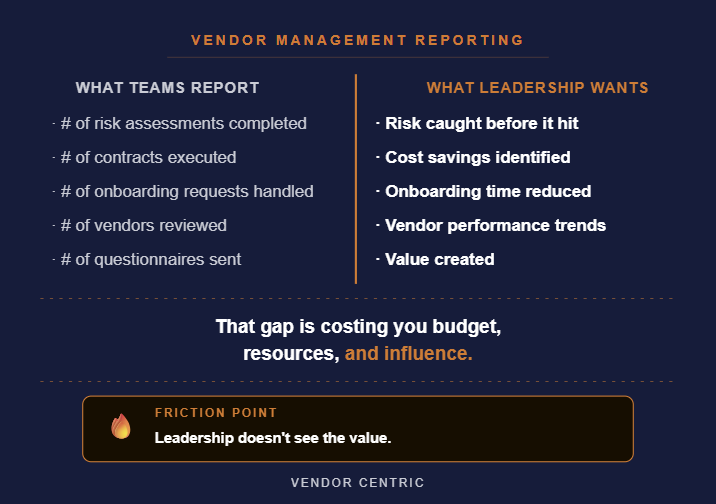
Teams are grinding, handling requests, completing risk assessments, getting contracts signed. They’re keeping things moving. But they’re not measuring anything that tells the story of what they’re contributing.
They’re not tracking how many risk issues were identified and resolved before a contract was signed. They’re not measuring whether vendors are actually delivering against their SLAs. They’re not showing how much faster onboarding has gotten compared to last year.
Without that, leadership doesn’t see a strategic function. They see overhead. They see a compliance process. Sometimes all they see are the problems: risk assessments backing up, contracts taking too long.
That has real consequences. You can’t get budget. You can’t get resources. You can’t make the case for investment when no one understands what you’re contributing.
The root cause is a governance and continuous improvement gap. Without defined reporting structures and a discipline around measuring outcomes, not just activity, the function has no reliable way to demonstrate its value or build on what’s working. It’s not that the value isn’t there. It’s that no one built the system to surface it.
Addressing this friction doesn’t require a major overhaul. It starts with identifying a handful of metrics that connect to outcomes leadership actually cares about, risk mitigated, cost savings identified, onboarding speed, vendor performance trends, and building the habit of reporting them consistently.
The opportunity: leadership visibility that turns vendor management from a cost center into a function worth investing in.
What Friction Is Really Telling You
Friction in vendor management is rarely random. It shows up at predictable points across the vendor lifecycle and when you trace it back, it almost always leads to a crack in one of the fundamentals that hold the program together: strategy, infrastructure, resourcing, enablement, governance, or continuous improvement.
That’s an important distinction. Friction isn’t a sign that your team isn’t working hard enough. It’s a sign that the foundation underneath the work has gaps. And no amount of effort, new software, or process tweaking will fix it sustainably until those gaps are addressed.
Take the most common one we see: things getting dropped because nothing is coordinated in a unified way. On the surface it looks like a communication problem or a staffing problem. But when you dig into it, it’s almost always a strategy gap. There’s no unified operating model defining how vendor management works across the organization, no shared framework that departments are working from, and no governance structure holding it together. Fix the communication and nothing changes. Fix the foundation and the coordination problem largely solves itself.
The friction is the signal. The fundamentals are where the answer is.
What to Do About It
The good news is you don’t have to fix everything at once. A program refresh starts with being honest about where your friction is loudest, tracing it back to the root cause, and addressing that first. Build momentum with a visible win and go from there.
That’s easier said than done when you’re inside it. It’s hard to see your own foundation clearly when you’re busy keeping the program running. That’s where an outside perspective helps, not to tell you what’s broken, but to help you see what the friction is actually telling you and build a practical path to fixing it.
At Vendor Centric we help organizations do exactly that. We assess where the cracks are in the fundamentals, prioritize what to address first, and work alongside teams to build a foundation that reduces friction systematically and keeps it from coming back.
The goal isn’t a perfect program all at once. It’s a program that runs better, scales better, and keeps getting better over time.
Common Questions About Vendor Management Program Friction
How do I know which friction points to address first?
Start where the pain is loudest. The friction point your team complains about most, or that the business feels most acutely, is usually pointing at the biggest gap in your foundation. Fix that first, build some momentum, and the path forward tends to get clearer from there.
Won’t new technology just remove the friction?
It’s the instinctive move and it rarely works on its own. Technology amplifies what’s already there. If the underlying foundation has gaps, new software doesn’t remove the friction, it automates it and makes it more visible to more people. The organizations getting the most out of modern vendor management technology fixed their foundation first and then let the technology do its job.
People seem to be a big part of the friction. How do I get them to change?
People respond to the system they’re working in. When there are no clear standards defining how things should work, no training or tools to help them do it, and no accountability when things go sideways, inconsistent behavior is the natural result. Address those three things and most of the people friction takes care of itself.
What does leadership actually want to see?
They want evidence that vendor management contributes to outcomes they care about. Risk caught before it became a problem. Money saved through smarter contracting or vendor consolidation. Onboarding that didn’t slow the business down. That shift from reporting activity to reporting outcomes is what changes the conversation.
What does a vendor management program refresh actually involve?
It starts with an honest assessment of where you are. What friction are you feeling, where is it showing up, and what’s actually causing it. From there you build a prioritized plan that goes after the root causes, not the symptoms, and execute against it in a way that builds momentum and delivers visible improvement over time. It rarely means starting over. It means finally addressing what the friction has been telling you all along.
Key Takeaways
- Friction in vendor management is rarely random. It accumulates at predictable points across the lifecycle and traces back to gaps in the fundamentals that hold the program together: strategy, infrastructure, resourcing, enablement, governance, or continuous improvement
- Friction points aren’t just problems. They’re signals, and they’re where the opportunity is. Each one is pointing at something that, if fixed at the root, creates lasting value
- Buying new technology without addressing the underlying gaps doesn’t remove friction. It amplifies it
- A compliance-first mindset is a strategy gap. A refresh means expanding what the function is accountable for, not just improving how it executes the compliance work
- Untrustworthy vendor data blocks good decision making and AI adoption. It’s often the foundation friction point that makes everything else harder
- A program refresh starts with an honest assessment of where you are, identifying the friction and its root causes, and executing a prioritized plan that builds momentum and delivers lasting improvement
If these friction points sound familiar, it’s time to take a closer look at your foundation. Start with an honest assessment and contact us to begin the conversation.