


 Laura has over 30 years of experience managing strategic & operational suppliers across 52 countries, conceptualizing and designing governing frameworks, and managing third-party risk has resulted in Laura’s ability to advise our clients to drive key strategies to optimize and enhance their vendor management operations.
As a third-party risk practitioner and consultant, I’ve worked with hundreds of stakeholders across multiple industries. One of the fundamental questions I always hear is, “Who qualifies as a third party?”
It’s a great question because an organization’s third-party ecosystem encompasses much more than suppliers.
Who is a Third-Party When It Comes to Risk Management?
A third-party is any company or individual outside of your organization with whom you have entered into a business relationship – regardless of whether or not you have a formal contract.
Most organizations work with a wide range of external entities and individuals that can pose potential risks. In third-party risk management, those entities and individuals can vary depending on the nature of your business, industry, and specific operational requirements.
Here are just a handful of common categories of third parties that organizations typically need to consider when it comes to third-party risk management:
1. Outsourced Service Providers
- Employee benefits administration
- Recruitment and staffing agencies
- Human resources
- Accounting
- Payroll Processing
2. Technology Partners
- IT service providers
- Cloud service providers
- Software providers
- Software hosting companies
- Hardware manufacturers
- Data processing companies
3. Financial Partners
- Banks and financial institutions
- Credit card processors
- Investment firms
- Credit Reporting Agencies
4. Legal and Professional Services
- Consulting firms
- Law firms
- Accounting firms
- Advertising and marketing agencies
5. Material Suppliers and Logistics
- Raw material suppliers
- Component suppliers
- Finished goods suppliers
- Shipping and logistics companies
- Transportation providers
The sheer diversity and prevalence of third parties within most organizations can often take one by surprise. Many organizations don’t realize the extent of their engagement with third parties.
This is why it’s so important to take a comprehensive approach to third-party risk management. It’s the only way to ensure third-party risk is identified, assessed, and mitigated so that your organization is protected from the potential challenges arising from third party relationships.
Case Study: Legal & General America
Read how Vendor Centric helped Legal & General America establish a comprehensive and compliant third-party risk management program.
Read Case Study
What is Third-Party Risk Management?
Third-party risk management is an organization’s systematic process to monitor and mitigate potential exposure to problems, harm, or loss that may arise from interactions with third parties. The primary goal of third-party risk management is to fortify the organization against various threats, including financial instability, regulatory non-compliance, data breaches, and other vulnerabilities that might come from interactions with external partners.
The process of third-party risk management involves a series of strategic steps aimed at fostering a proactive and vigilant approach to potential challenges. Here’s an overview of a standard, six-step process.
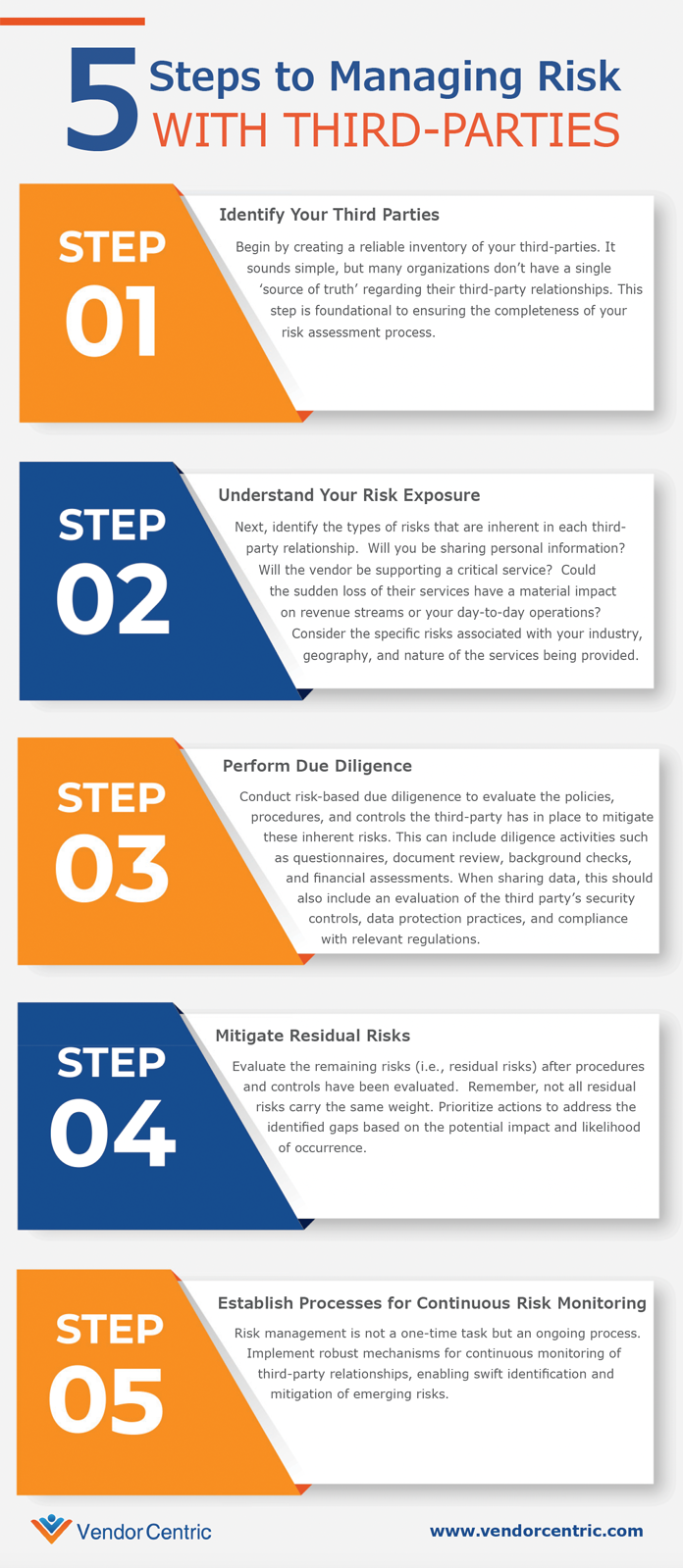
What About Fourth Parties?
There is a component of third-party risk management that is often overlooked, and that’s the concept of fourth-party risk.
Fourth parties are the ‘vendors of your vendors.’ You don’t have a direct relationship with them, but they can pose significant risks to you.
For best practices on fourth-party risk management, check out this related post on Practical Guidelines for Managing Fourth-Party Risk.
Don’t Let Risks with Third-Parties Catch You Off Guard
Managing risk with third parties involves recognizing the expansive array of external entities that can impact your organization’s operations. From service providers and technology partners to financial institutions, the diversity of third parties is extensive and often catches organizations off guard.
To effectively manage these risks, it’s essential to take a process-driven, comprehensive approach to third-party risk management. Be proactive and vigilant to safeguard the business and build resilience against potential threats.
Want to learn more on this topic? Be sure to check out 5 Best Practices for Successful Vendor Risk Assessments and Incorporating KRIs Into Your Third-Party Risk Management Reporting.
Vendor Centric can help your organization identify and mitigate risk with your third parties, and establish solid risk management policies, procedures, and systems.
Contact us to schedule a free, no-hassle consultation to explore your needs and how we can help.
2026 Third-Party Risk Management Market
The third-party risk management (TPRM) market is experiencing explosive growth, valued at $7.42 billion in 2025 and projected to reach $20.59 billion by 2030—representing a remarkable 17.8% CAGR, making it the fastest-growing segment in the vendor management space.
This growth is driven by:
- AI-Driven Risk Scoring: 85+ TPRM tools now offer AI-powered risk assessment capabilities
- Continuous Monitoring: Real-time risk monitoring replacing periodic assessments
- Regulatory Pressure: Increasing compliance requirements across industries
- GenAI Adoption: 89% of executives are advancing generative AI initiatives in risk management
Frequently Asked Questions About Third Parties
What’s the difference between third-party and fourth-party vendors?
A third-party vendor is an organization you directly contract with to provide goods or services. A fourth-party vendor is a subcontractor or supplier that your third-party vendor uses—you don’t have a direct contractual relationship with them, but they can still pose risks to your organization. Fourth-party risk management is becoming increasingly important as supply chains grow more complex.
Are contractors considered third parties?
Yes, independent contractors and freelancers are considered third parties. They have access to your systems, data, or facilities but aren’t employees. This includes consultants, temporary workers, gig economy workers, and professional services providers. They require the same risk assessment and management as other third-party vendors.
How do you identify all your third parties?
Conduct a comprehensive third-party inventory by reviewing: (1) Accounts payable records, (2) Contract management systems, (3) IT system access logs, (4) Department-level vendor lists, (5) Purchase order histories, and (6) Employee expense reports. Many organizations are surprised to discover they have 2-3x more third parties than initially estimated.
Related Resources
Learn more about vendor management best practices:
- Is Your TPRM Program Stuck?
- Developing Third-Party Management Policies
- How to Use Contracts to Reduce Risk with Critical Vendors
Last Updated: January 5, 2026


